Not all writing is the same
The problem with writing is that it’s an invisible activity. All we see people do is sit behind a screen, typing on a keyboard. Consequently, most students (and supervisors) don’t have explicit language for the different writing activities. This reduces our awareness of these activities, and can lead to problems such as:
- Spending 45 minutes polishing the opening sentence of a paragraph, then realising later that the entire paragraph doesn’t even belong in the paper.
- Jumping straight into interpreting your results without writing down the specific question you’re trying to answer, so you end up just staring at plots hoping answers will magically appear.
- Drafting your Discussion section before you’ve really figured out what your main finding is, so you write vague generalities about “future research” and “further studies needed” because you don’t yet know what conclusion to draw.
It can also lead to confusing advice on how to start writing, such as:
- Start with the Methods: Without first knowing exactly what question you’re trying to answer, you end up just listing technical steps without a clear purpose. It feels productive because you’re writing words, but you’re really just delaying the harder work of figuring out what your data actually mean. You write a lot about your protocol, but it doesn’t connect to any specific argument.
- Start with the Abstract: This means trying to write a summary of your conclusions before you’ve actually analysed your findings. Experienced researchers can do this because they’ve done similar studies before and know what to expect. But if you’re new to the field, you can’t predict what your data will show before you’ve finished interpreting it. You’ll end up with a promise you can’t keep, or a vague summary that doesn’t match your actual results.
Breaking down the writing process
Roughly, I like to divide the writing process into two main activities based on two different goals:
- Discovery: Knowledge building; sense-making — this is writing for yourself.
- Communication: Communicating said knowledge — this is writing for an audience.
We can divide these categories further into:
- Discovery
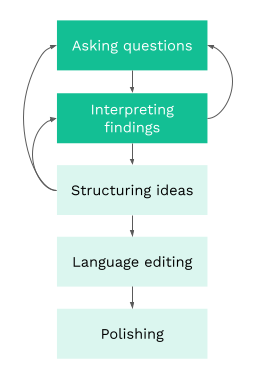
- Asking questions: Establishing exactly what question you want to answer and how you’ll look for the answer. This includes defining the knowledge gap, scoping the literature, setting methodological boundaries (which includes designing and executing data collection). In practical terms, this means drafting the Introduction and Methods.
- Interpreting findings: Answering the questions using the available knowledge — your findings (results) and other people’s findings (literature). This is the generative work of making sense of results within the questions you asked. In practical terms, this means drafting the Results and Discussion.
- Communication
- Structuring your ideas: Develop a logical narrative that convinces your audience that your interpretation of the data, given the research questions, is the most likely one (i.e. building trust). This includes (reverse) outlining and structuring your paragraphs.
- Language editing: Writing clear, readable language that matches the style of your target audience (see also Language conventions).
- Polishing: Proofreading grammar, spelling, abbreviations, citations, etc.
Writing is not linear
Roughly, you will go through these stages linearly. You start by asking questions, than interpreting the findings to answer them, then to structuring your ideas, etcetera — it’s obvious that language editing or polishing when you’re only writing for yourself makes little sense; you might delete those sentences once you re-interpret your data, so polishing them early wastes effort.
However, I say roughly because the process is more like building a logic puzzle than like following a recipe. More often than not, you learn something about your findings (x), which reshapes the question you posed (y), which in turn changes how you must present the findings (x). The phases kind of ping-pong back and forth until everything aligns. In practical terms, you’ll often find that you need to tighten the Introduction after working on the Discussion.
Moreover, structuring ideas can often expose gaps that lead you back to re-interpreting your the data.